
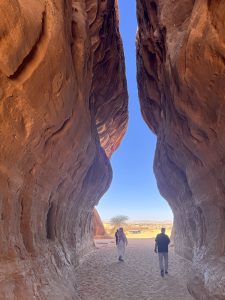
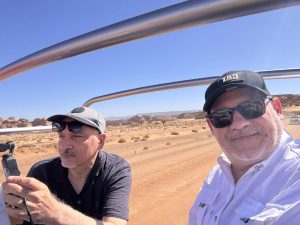
The desert of northern Saudi Arabia stretches before me like an endless ocean of reddish sand and rocks rising in impossible formations. The sun beats down relentlessly, and each step crunches on the dry sand as I make my way toward Hegra, also known as Mada’in Salih, the Nabatean city that, centuries ago, connected Arabia with Petra and the trade routes of the Mediterranean and Mesopotamia. Walking here is not simply traversing a landscape: it is stepping through layers of history that wind, sand, and time have silently laid bare, inscribed on every stone.

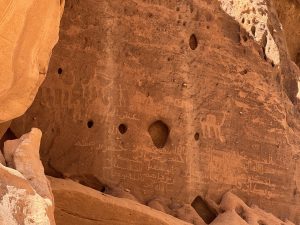
Hegra retains an aura of mystery that fascinated early European explorers. Charles Montagu Doughty, a 19th-century English adventurer, was the first to document its ruins. He joined a caravan of pilgrims bound for Mecca, surrounded by thousands of Muslims and camels. Armed only with a notebook, a knife hidden up his sleeve, and an insatiable curiosity, Doughty faced grueling days, freezing nights, and the constant need to gain the trust of the Bedouin who controlled the region. He was the one who discovered inscriptions in Lihyanite, Dadanite, Nabataean, and Latin—messages carved in stone by traders, rulers, and tribes who inhabited this region more than two thousand years ago.
Today, as I explore Hegra, I feel the same mixture of fascination and awe that Doughty must have experienced. The monumental tombs, with their ornate facades, carved columns, and geometric motifs, reflect the sophistication of a civilization that organized trade routes, religious rituals, and social relationships with astonishing precision. The inscriptions recount names, tributes, and ceremonies, creating a mosaic of languages and cultures that has withstood the test of time and allows us to reconstruct life in this remote desert oasis.
As I walk among the mounds, sand gets into my boots and the wind stirs up wisps of clouds that seem to whisper tales of traders, pilgrims, and artisans. The shadows cast by the rocks at sunset lend a theatrical air to the tomb facades, and one can imagine the Nabataeans watching from above as their structures withstood the unforgiving desert climate. Each facade bears its own unique mark: carved figures, meticulously engraved inscriptions, and architectural elements that connect Hegra to Petra, revealing a cultural exchange that spanned deserts and mountains.
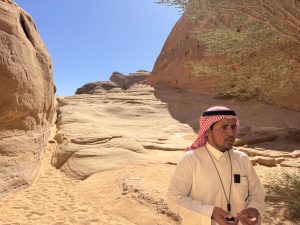
As I made my way toward the heart of the site, I heard the crunch of sand beneath my feet, the occasional barking of nearby dogs, and the wind whistling through the stones. Each tomb I visited revealed surprising details: inner chambers, niches carved for offerings, symbols that have yet to be fully deciphered. Archaeologists explained that each find was a piece of a larger puzzle, one that helped to understand how trade routes moved, how desert dwellers lived, and how cultures and languages mingled in this strategic location.
The sun descends slowly, painting the sand and stone facades orange and violet. The temperature drops rapidly, and the desert chill reminds me that here, as centuries ago, survival depends on preparation, patience, and respect for an environment that does not forgive mistakes. As I write these lines beneath a starry sky that seems to spill over Hegra, I think of explorers like Doughty, brave and inquisitive, facing caravans, camels, and unfamiliar cultures; Renan, analyzing stones and words from a European desk; and the Nabataeans themselves, who made this place an oasis of history and architecture.
Hegra is more than ruins; it is a story that is perceived through the senses. It is heard in the wind, touched in the texture of the rock, smelled in the dry desert earth, and felt in the vastness of the landscape. Every stone has a story, every inscription a message from those who lived, traded, and died here. For the journalist who visits it, Hegra is a lesson in patience, fascination, and respect: a reminder that history is not only read, but experienced.
As night falls, Hegra is enveloped in silence. The stars illuminate the tombs and forgotten paths, and one can imagine the caravans of old, laden with spices, incense, and dreams, traversing endless routes beneath this very sky. Visiting Hegra is not merely an archaeological experience; it is an immersion in a time where every stone, every shadow, and every inscription connects the living to the echoes of a millennia-old past, uniting explorers, historians, and modern travelers in a silent dialogue with history.